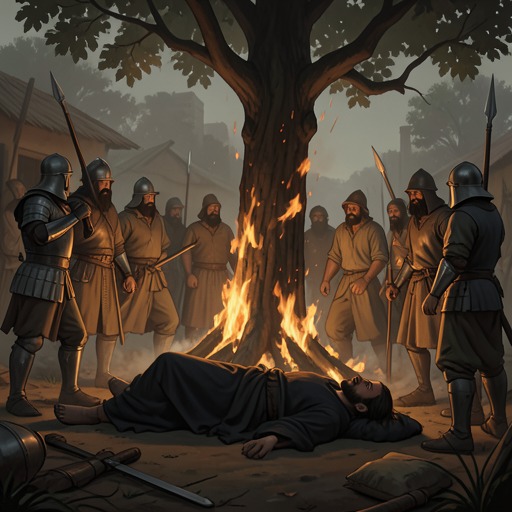
Pang Tong's death at Fallen Phoenix Valley
The Romance of the Three KingdomsPang Tong’s death at Fallen Phoenix Valley is the fatal reversal in Xuande’s campaign to conquer Shu: an ambush meant for Xuande kills the strategist instead, and the loss brings the advance to a halt until Kong Ming can come from Jingzhou. The scene binds practical misdirection to foreboding signs. Pang Tong hears the valley’s name, recognizes its ominous fit with his Daoist title, and tries to turn back—but the arrows are already falling.
Warnings and Rival Interpretations
Before the fatal march, Kong Ming sends word that he has seen astrological features like those observed by Peng Yang and wants Xuande to take care. Pang Tong takes offense, interpreting the warning as an attempt by Kong Ming to diminish his achievements. He tells Xuande that he too has seen the signs, but insists that they concern the conquest of Shu, not an impending disaster. In his reading, they point to the death of Ling Bao and therefore declare that the time to attack has arrived.
Xuande is not so easily reassured. A disturbing dream has left him with pain in his right arm: he dreamed that a demon struck it with a club, and the arm hurt when he awoke. He asks whether this, too, might be a warning. Pang Tong dismisses the concern, attributing Kong Ming’s caution to rivalry over who will gain fame, and urges the campaign forward. The scene leaves Xuande caught between competing interpretations of signs and strategy; neither his misgivings nor Kong Ming’s warning is allowed to stop the march.
The Horse and the Ambush
On the morning of the battle, Pang Tong’s horse proves difficult to manage. Xuande exchanges horses with him, giving Pang Tong his own grey mount and taking the unsettled horse for himself. The exchange is an ordinary act of accommodation with extraordinary consequences: Shu’s defenders have been forewarned of the attack, and when Zheng Ren’s men spot a rider on the grey horse, they identify it as Xuande’s and prepare an ambush in hopes of capturing him. The mistaken identity redirects the danger from the ruler to the man riding in his place.
Pang Tong enters a narrow valley and asks where they are. When told it is Fallen Phoenix Valley, he becomes alarmed: his Daoist name is Young Phoenix, and he sees the place-name as a dire match. He orders a retreat, but the decision comes too late. Arrows and crossbow bolts rain down on him and his men. Pang Tong dies alongside many of his followers at thirty-six, while Xuande survives the trap that had been prepared for him.
The Song and the Omen
The ambush gives terrible specificity to a children’s song that had circulated beforehand. It speaks of a phoenix and a dragon arriving in Shu together, then predicts that partway along the road to Luocheng, on the mountainside, the phoenix will die. Its imagery makes Pang Tong’s death feel both immediate and already foretold: the route, the mountain setting, and the title “Young Phoenix” converge in the event itself. The song does not prevent the tragedy; once Pang Tong falls, it becomes a frame through which the loss can be recognized.
The poem’s paired figures also give the death a wider resonance. Pang Tong and Kong Ming have been associated with the phoenix and dragon, respectively, and the song imagines them arriving in Shu side by side. The phoenix’s fall thus marks the breaking of that pairing during Xuande’s campaign. The ominous prediction does not explain the tactical chain—the horse exchange and the defenders’ mistake do that—but it makes the outcome seem inscribed in the landscape before the ambush is sprung.
Grief and the Campaign’s Pause
The battle continues to swing between Xuande’s forces and the defenders. Zheng Ren nearly captures Xuande, but thirty thousand of Xuande’s troops intervene and save him. Back at camp, Xuande hears that Pang Tong has died and breaks down in tears, facing west. The news changes the campaign’s immediate course: Xuande decides that Kong Ming is needed, sends messengers to fetch him from Jingzhou, and forbids his commanders to go out and fight Zhang Ren, who repeatedly rides up to taunt them, until Kong Ming arrives.
Kong Ming learns of the death before any messenger brings the news. In Jingzhou, he watches the night sky and sees a huge star fall to earth; he understands it as a sign that Pang Tong has died. When Xuande’s letter arrives asking him to come, Kong Ming appoints Guan Yu to protect Jingzhou and tests his plans for what should happen if Cao Cao attacks, or if Cao Cao and Sun Quan attack together. He then gives Guan Yu eight words of strategic instruction: ‘North – resist Cao Cao; east – reconcile Sun Quan.’ Pang Tong’s death is therefore not only a bereavement for Xuande and Kong Ming; it also calls Kong Ming away from Jingzhou and forces an immediate transfer of responsibility for its defense.
Significance in the Shu Campaign
The death is produced by the collision of practical choices and rival readings of uncertainty. Pang Tong presses forward after dismissing Kong Ming’s warning; Xuande’s unease persists, but the campaign proceeds; a horse swap then causes the enemy to mistake Pang Tong for the intended target. Neither astrological signs nor the name of the valley supplies a tactical escape. Instead, foreknowledge heightens the reader’s awareness of danger while the decisive circumstances remain contingent and human.
For Xuande’s effort to conquer Shu, Pang Tong’s fall removes a central commander and interrupts the advance at a moment when the campaign still depends on skilled leadership. Xuande’s grief, his refusal to resume the fight before Kong Ming arrives, and Kong Ming’s recognition of the death from a falling star carry the loss across distance: the battlefield is in Shu, but its consequences are felt in Jingzhou. The phoenix dies on the road to Luocheng, and the dragon must leave his post to take up the work left unfinished.